Menu

Le Roi du Jardin
Gardens, parks and designed landscapes.
Historic gardens and parks that are worth the journey in themselves
Explore the collection- 271places
- 17Countries
- 150From source records
Bagnaia, Lazio — Ljuba brank · Wikimedia Commons · CC BY-SA 4.0
Provenance
This world opens with castles and estates whose Base Mérimée record mentions a garden. Gardens that exist as gardens — Villandry as a garden rather than as a castle — are not in the dataset yet. What follows is therefore what the source provides, not what the world will become.
01 — The collection
Gardens, parks and designed landscapes.
Gardens and parks worth visiting in their own right — including those attached to a castle that already appears in Le Roi du Château.

Abbot's Palace (Oliwa)
The Abbot’s Palace in Oliwa houses the Modern Art Collection and Theatre Department of the National Museum in Gdańsk. Other departments of the same branch occupy the separate NOMUS building. An associated outdoor sculpture gallery stands in Oliwa Park.
Editorial selectionCC BY-SA 3.0 pl

Albury Park
Albury · South East England
Albury Park is a Grade II* listed building in Albury, England, United Kingdom. This concise register entry is based on Historic England’s National Heritage List for England.
Editorial selectionPublic domain

Alhambra
The Alhambra served as a palatine city, Christian royal residence and military fortress before its designation as a monument in 1870. It housed the Nasrid sultans, court officials and elite soldiers. After 1492 it became a royal residence under the Tendilla administration.
Editorial selectionCC0

Alton Towers
Farley · West Midlands
Alton Towers is a château at Farley, in the United Kingdom. The recorded building campaign dates from the 19th century. Its architecture is recorded as Gothic Revival. The register records it as “Grade II* listed building”. Details are drawn from Wikidata.
Editorial selectionCC BY-SA 2.0

Alvøen Manor Gardens
Alvøen lies west of central Bergen and combines a manor, gardens, parkland and a historic industrial settlement. The Fasmer family established paper production in 1797, and the manor became their permanent residence in 1808. Bymuseet identifies an avenue, a pavilion, an orchard and an English-style park among the estate’s landscape features. The gardens have changed through successive periods of cultivation. The museum currently describes the garden as open, with access to the house limited to groups and pre-booked guided visits.
Editorial selectionCC BY-SA 4.0

Ancien château Klinglin
Illkirch-Graffenstaden · Bas-Rhin
Ancien château Klinglin is a château at Illkirch-Graffenstaden, Bas-Rhin, in the Grand Est region of France. The recorded building campaign dates from the 18th century. It is protected as a monument historique at the second level (inscrit). Details are drawn from the Base Mérimée of the French Ministry of Culture.
Source recordCC BY-SA 3.0

Arboretum de l'École du Breuil
The Arboretum de Paris, associated with the École Du Breuil, was laid out and planted between 1945 and 1960 according to the school’s history. It is one of the four sites of the Jardin Botanique de Paris. Its tree collections combine broadleaved species and conifers with environments including a wetland and calcareous meadow, and support botanical study by the school’s students.
Editorial selectionCC BY-SA 3.0

Athelhampton Hall
Athelhampton · South West England
A Dorset manor whose surviving hall is associated with Sir William Martyn, set within a property with an earlier manorial history and later formal gardens.
Editorial selectionCC BY-SA 3.0

Audley End House
Saffron Walden · East of England
Audley End House is a château at Saffron Walden, in the United Kingdom. The recorded building campaign dates from the 17th century. Its architecture is recorded as Jacobean architecture. The register records it as “Grade I listed building”. Details are drawn from Wikidata.
Editorial selectionCC BY-SA 4.0

Belsay Castle
Belsay
Belsay Castle is a château at Belsay, England, in the United Kingdom. The recorded building campaign dates from the 15th century. The register records it as “scheduled monument”. Details are drawn from Wikidata.
Editorial selectionCC BY-SA 2.0

Belton House
Belton and Manthorpe · East Midlands
Belton House is a château at Belton and Manthorpe, in the United Kingdom. The recorded building campaign dates from the 17th century. Its architecture is recorded as restoration style. The register records it as “Grade I listed building”. Details are drawn from Wikidata.
Editorial selectionCC BY-SA 3.0

Bergen Museum Garden
The Museum Garden, Muséhagen, lies beside the University Museum in central Bergen. It was laid out in 1897–1899 to a plan by botanist Jørgen Brunchorst, as an outdoor continuation of the museum’s botanical exhibitions. The protected garden holds living collections of perennials, shrubs and trees, with glasshouse collections as well. It supports research, teaching, public engagement and recreation. The University of Bergen publishes separate seasonal opening times for the garden and limited visiting hours for the glasshouse. This central garden is distinct from the university’s collections at Milde.
Editorial selectionCC BY-SA 3.0
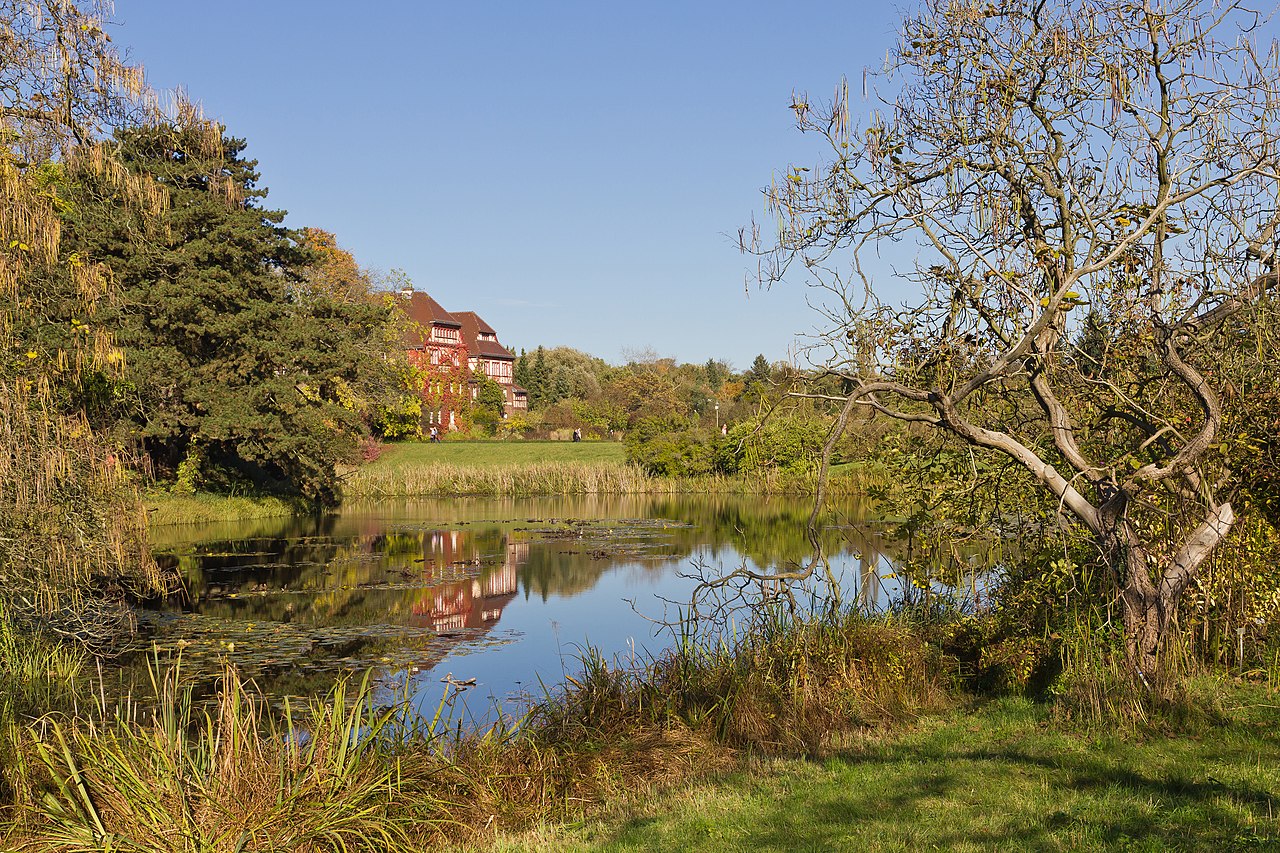
Berlin Botanical Garden and Botanical Museum
Berlin’s botanical garden covers 43 hectares and reports a collection of almost 20,000 plant species. Its associated museum concerns plants and their cultural and natural history. The institution also researches the diversity of plants, fungi and algae.
Editorial selectionCC BY-SA 3.0

Bicton House
Bicton · South West England
Bicton House is a château at Bicton, in the United Kingdom. The register records it as “Grade II* listed building”. Details are drawn from Wikidata.
Editorial selectionCC BY-SA 2.0

Biddulph Grange
Biddulph · West Midlands
Biddulph Grange is a château at Biddulph, in the United Kingdom. Its architecture is recorded as Renaissance Revival architecture. The register records it as “Grade II* listed building”. Details are drawn from Wikidata.
Editorial selectionCC BY-SA 4.0

Birmingham Botanical Gardens
Editorial selectionCC BY-SA 2.0

Blenheim Palace
Blenheim · South East England
Blenheim Palace is a château at Blenheim, England, in the United Kingdom. The recorded building campaign dates from the 18th century. Its architecture is recorded as English Baroque. The register records it as “World Heritage Site”. Details are drawn from Wikidata.
Editorial selectionPublic domain

Botanical garden of Düsseldorf
Düsseldorf’s botanical garden supports research and teaching at HHU. Its plant collections provide living material as part of the garden’s work for science. The garden also trains horticultural apprentices in perennial-plant cultivation and presents science-related exhibitions in its orangery and outdoor grounds.
Editorial selectionCC BY-SA 4.0

Botanical Garden of the University of Halle-Wittenberg
Halle's botanical garden began in 1698 as a medicinal garden linked to the university. Its medicinal plants formed part of medical students' teaching. The garden was enlarged in 1787, and by around 1800 it cultivated approximately 3,000 different plant species.
Editorial selectionCC BY-SA 3.0

Botanical Garden of the University of Heidelberg
Heidelberg’s university botanical institution dates to 1593. The university describes its work in research, learning, conservation of threatened plants and public education. Its collections support scientific and conservation activity, and an associated herbarium holds approximately 350,000 specimens.
Editorial selectionCC BY-SA 3.0

Botanical Garden of the University of Zurich
The University of Zurich’s botanical garden in Seefeld includes domed display houses and around 7,000 plant species. It forms part of the Institute for Systematic and Evolutionary Botany, linking the garden to university research and teaching. It also belongs to the Museumsnetz Zürich network.
Editorial selectionCC BY-SA 4.0

Botanical Garden of TU Braunschweig
Braunschweig’s university botanical garden was founded in 1840 and developed from a garden of the anatomy school. An expansion in 1995 brought its area to about three hectares. The garden now holds roughly 4,000 plant species and supports research in plant science.
Editorial selectionCC BY-SA 4.0

Botanical Garden, Bonn
The University of Bonn’s botanical gardens include a palace garden, greenhouses and a useful-plant garden. Their collections were assembled for research and teaching and include carnivorous plants. The institution describes more than two centuries of work in research and education.
Editorial selectionCC BY-SA 4.0

Botanika
Botanika in Bremen presents a Japanese garden, environments associated with Borneo’s cloud forests and the Himalayas, and a tropical house. Its discovery centre introduces plant phenomena and the relationship between nature, people and science. Butterflies also feature in its tropical displays.
Editorial selectionCC BY-SA 4.0